How to Calculate Rental Property Cash Flow: 8 Costs to Include
Rent minus the mortgage isn't what your building makes. Here are the 8 costs to include, and how to build a 12-month projection you can trust.

Ask a landlord what a building makes. Most will do quick math: rent minus the mortgage.
Ask what it will make over the next 12 months, after every cost, and most will guess. I know I used to. Ask me why? I don't know.
If the rent covered the mortgage with room to spare, I called it a good building. Then I sat down and projected 12 months, line by line, for every property I own. Some of my "good buildings" were barely breaking even.
One definition first. In this article, cash flow means the money left over after paying your property's bills and setting aside money for future repairs.
Why doesn't rent minus PITI tell you your cash flow?
It counts the two biggest numbers and skips the rest.
Here's an example. A 6-unit building rents for $97,200 a year. The mortgage, taxes and insurance cost $52,000. Rent minus PITI is $45,200. Looks great.
Now count every cost for 12 months. The building's cash flow is $3,400.
The numbers above are a made-up example, not one of my properties.
How do you calculate rental property cash flow?
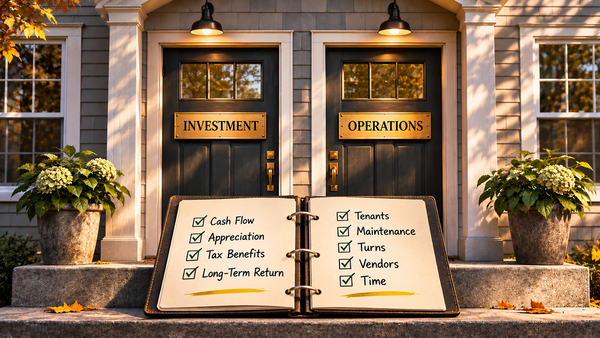
Eight lines. Go in this order:
- Rent. Unit by unit, with each lease end date and renewal rent.
- PITI. Your full payment, plus any taxes or insurance you pay outside it.
- Vacancy and bad debt. The rent you don't expect to collect.
- Utilities and city services you pay. Trash, sewer, water, common electric, snow.
- Overhead. Bookkeeping, software, legal. Splitting it evenly across your units is a simple starting point.
- Property management. Even if you do it yourself.
- Repairs and turns. Small fixes, plus the move-outs you expect.
- Capex. Savings for big items like roofs and boilers.
What's left is your cash flow.
Which rental property expenses do landlords miss most?
If you've been using rent minus PITI, you're in good company. Most of us learned it that way. These three costs are easy to miss because they don't come with a monthly bill.
Vacancy and bad debt. Vacancy is the rent you lose when a unit is empty. Bad debt is the rent you lose when a tenant doesn't pay. Both cut your income. A 1-bedroom in a busy area might sit empty two weeks. A 3-bedroom house in a slow area might sit two months. Use your own history and your local listings. One warning: if you've already left a specific unit empty for a few months in your projection, don't take a vacancy percentage on top of it. That counts the same empty months twice.
Management. If you manage your own buildings, you have two jobs: owner and manager. Pay yourself for both. Charge each property a management fee, even if it goes to you. Then you can see what the building earns on its own. If a property only makes money because you work for free, you're getting paid for your labor, not earning a return on your investment.
Capex. Big repairs are easy to forget until they happen. For example, a roof that needs to be replaced in the next 5 years for $20,000 needs at least $4,000 a year set aside to cover it when it's time.
A standard reserve per unit is a good starting point. But if you know a roof, boiler or other big item will need replacing soon, build that cost into your reserve plan.
Why do we skip these costs?
The mortgage comes every month, so we remember it. The roof only shows up the day it leaks. We plan for what we see often and forget what we don't.
A good projection fixes that. Ask yourself: what could make this building lose money? Then put each answer in your numbers.
How do you keep a 12-month projection accurate?
Two rules make or break it.
Plan forward. Don't copy last year. Last year had its own good and bad luck. Build the next 12 months from what you know is coming.
Check it every 3 months. Compare your plan to what really happened, and fix what was off. Within a year, your projections get much more accurate.
So what do you do with it?
Pick one property. Build its 12-month projection. Then compare its cash flow to rent minus PITI.
The difference shows how far off the quick math was. Do this for every property, and you're ready to build your hump chart.
Want help building yours? It's the first thing we do in the Rental Portfolio Review. Start with a free 15-minute call and tell me what you own.